
 3 hours ago
1
3 hours ago
1
Roja Assadiand Sarah Namjoo,BBC Persian

 Public domain
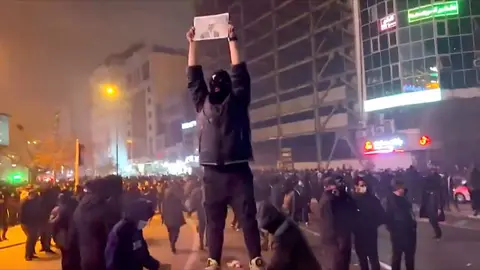
A protester holds up a picture of crown prince Reza Pahlavi in Kaj Square, north-western Tehran on Friday
"I saw it with my own eyes - they fired directly into lines of protesters, and people fell where they stood."
Omid's voice was shaking as he spoke, fearful of being traced. Breaking the wall of silence between Iran and the rest of the world takes immense courage, given the risk of reprisals by the authorities.
Omid, in his early 40s and whose name we have changed for his safety, has been protesting on the streets of a small city in southern Iran over the past few days against worsening economic hardship.
He said security forces had opened fire at unarmed protesters in his city with Kalashnikov-style assault rifles.
"We are fighting a brutal regime with empty hands," he said.
The BBC has received similar accounts of the crackdown by security forces following the widespread protests across the country last week.
Since then, internet access has been cut by the authorities, making reporting from Iran more difficult than ever. BBC Persian is banned from reporting inside Iran by the government.
One of the largest nationwide anti-government protests took place on Thursday, the twelfth night of demonstrations. Many people appear to have joined the protests on Thursday and Friday after calls from Reza Pahlavi, the exiled son of the last shah of Iran who was overthrown in the 1979 Islamic revolution.
The following day, Iran's Supreme Leader Ali Khamenei said: "The Islamic Republic will not back down." It appears that the worst bloodshed occurred after that warning as security forces and the Islamic Revolutionary Guard Corps take their orders from him.
Iranian authorities accused the US and Israel of fomenting trouble and condemned "terrorist actions", state media reported.
A young woman from Tehran said last Thursday felt like "the day of judgement".
"Even remote neighbourhoods of Tehran were packed with protesters - places you wouldn't believe," she said.
"But on Friday, security forces only killed and killed and killed. Seeing it with my own eyes made me so unwell that I completely lost morale. Friday was a bloody day."
She said that, after Friday's killings, people were afraid to go out and that many were now chanting from alleys and inside their homes.
Tehran was a battlefield, she said, with protesters and security forces taking positions and cover on the streets.
But she added: "In war, both sides have weapons. Here, people only chant and get killed. It is a one-sided war."
Mortuary videos shows violent government crackdown in Iran
Eyewitnesses in Fardis, a city just to the west of Tehran, said that on Friday, members of the paramilitary Basij force under the Islamic Revolutionary Guard Corps (IRGC) suddenly attacked protesters after hours without a police presence on the streets.
The forces, who were in uniform and riding motorcycles, fired live ammunition directly at protesters, according to the witnesses. Unmarked cars were also driven into alleys, with occupants shooting at residents who were not involved in the protests, they said.
"Two or three people were killed in every alley," one witness alleged.
Those who have given accounts to BBC Persian say the reality inside Iran is hard for the outside world to imagine, and the death toll reported by international media so far only represents a fraction of their own estimates.
International news outlets are not allowed to work freely inside Iran and they are mostly relying on Iranian human rights groups who are active outside the country. On Monday the Norway-based Iran Human Rights (IHRNGO) said at least 648 protesters in Iran had been killed, including nine people under the age of 18.
Some local sources and eyewitnesses report very high numbers of people killed across different cities, ranging from several hundreds to thousands.
The BBC is currently unable to independently verify these figures and, so far, Iranian authorities have not provided official or transparent statistics on the number of deaths of protesters.
However, Iranian media has reported that 100 security personnel had been killed during the protests, saying that protesters - whom they refer to as "rioters" - set fire to dozens of mosques and banks in various cities.
 Eyewitness image
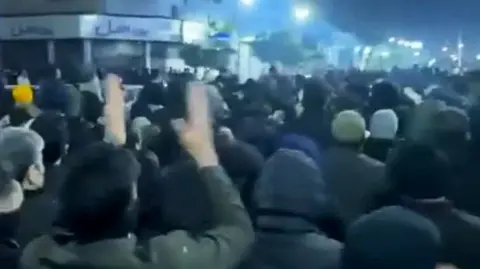
Footage posted on Thursday showed large crowds in Babol, northern Iran
 Eyewitness image
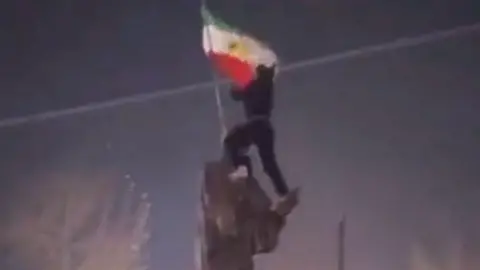
Images posted on Thursday from Khorramabad in western Iran showed a man holding Iran's pre-revolutionary flag
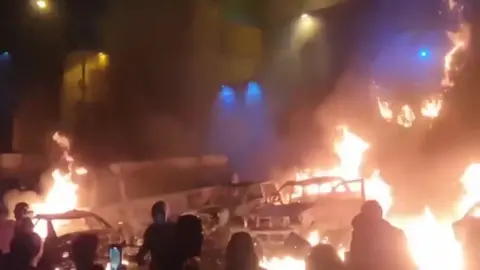
Videos verified by BBC Persian's fact-checking team also show police vehicles and some government buildings being set alight in different locations during the protests.
Testimonies and video sent to BBC Persian are mainly from larger cities such as Tehran, nearby Karaj, Rasht in the north, Mashhad in the north-east, and Shiraz in the south. These areas have greater access to the internet via the Starlink satellite network.
Information from small towns - where many early casualties occurred - is scarce as their access to Starlink is very limited.
But the volume, consistency, and similarity of the accounts received from various cities point to the severity of the crackdown and the widespread use of lethal violence.
Nurses and medics who spoke to the BBC said they had seen numerous dead bodies and injured protesters.
They reported that hospitals in many cities had been overwhelmed and were unable to treat those with severe injuries, especially to the head and eyes. Some witnesses reported bodies "stacked on top of each other" and not handed over to families.
 Eyewitness image / Reuters
Footage from Tehran that emerged on Friday showed cars ablaze
Graphic videos published on the activist-run Telegram channel Vahid Online on Sunday showed a large number of bodies at the Kahrizak Forensic Medical Centre in Tehran, with many families either mourning or attempting to identify the corpses.
In one of the videos apparently from Kahrizak, relatives are seen looking at the photos of unidentified bodies displayed on a screen.
Many bodies in black bags were visible in the facility and on the street outside, only some of which seem to have been identified.
One video showed the inside of a warehouse containing several bodies, while another showed a truck being unloaded with people removing corpses from it.
A mortuary worker in a cemetery in Mashhad said that before sunrise on Friday morning between 180 and 200 bodies with severe head injuries were brought in and buried immediately.
A source in Rasht told BBC Persian that 70 bodies of protesters were transferred to a hospital mortuary in the city on Thursday. According to the source, security forces demanded "payment for bullets" before releasing bodies to families.
At the same time, a medical staff member at a hospital in eastern Tehran told BBC Persian that on Thursday, around 40 bodies were brought there the same day. The hospital's name has been withheld to protect the identity of the medic.
UN Secretary-General António Guterres said on Sunday that he was "shocked by reports of violence and excessive use of force by the Iranian authorities against protesters resulting in deaths and injuries in recent days".
"I want to emphasise that regardless of the death toll, the use of lethal force by security forces is concerning," Mai Sato, the UN Special Rapporteur on the situation of human rights in the Islamic Republic of Iran, told BBC Persian.




 English (US) ·